
If you operate a dump truck or manage a fleet that hauls materials on public roads, federal law requires loads to be properly secured to prevent debris from escaping during transport. Most states have their own tarping and load containment rules, with fines ranging from $100 to $5,000, depending on the state, the type of material being hauled, and whether the violation resulted in property damage or injury. This guide explains federal baseline requirements, summarizes state-by-state regulations, and shows how tarp material and quality can help you stay compliant.
What Does Federal Law Require for Dump Truck Tarping?
The Federal Motor Carrier Safety Administration (FMCSA) sets the national standard for load securement under 49 CFR Parts 392 and 393. These rules apply to every commercial vehicle on public roads and override any less restrictive state laws.
Under 49 CFR 393.100, your cargo needs to be contained — it cannot leak, spill, blow, or fall off during transport. Tarps are not mandated by the FMCSA in every situation, but they do require securement systems like tarps, tie-downs, or covers whenever they’re needed to prevent cargo from escaping during transport. For dump truck fleets hauling loose aggregates, sand, gravel, or debris, that effectively means a tarp or equivalent cover is required.
Why Dump Truck Tarping Matters Beyond Compliance
DOT inspectors can issue violations for escaping material, damaged tarps, or improperly secured coverings found during a roadside inspection. But fines are only one piece of the equation. Loose aggregate, sand, gravel, and commercial waste create real hazards when they escape an uncovered dump truck at highway speeds:
Road safety. Even the smallest piece of gravel hurled out of an uncovered dump truck bed has enough force to crack a windshield. Dust clouds formed by exposing loads without a cover can reduce sight lines and increase accident risk.
Road surface damage. Loose stone and debris wear down road markings and shoulders, compounding maintenance costs for municipalities and liability exposure for carriers. Spilled tar and asphalt adhere to pavement and create uneven surfaces that become hazardous to drivers.
Environmental contamination. Waste taken from commercial facilities can escape during transport and contaminate nearby waterways and soil. This creates cleanup obligations and regulatory consequences that far exceed the cost of any tarp.
For fleet managers, the math is straightforward: a quality dump truck tarp costs a fraction of a single DOT fine, and it eliminates the liability exposure, downtime, and reputational risk that come with an unsecured load violation.
State-by-State Dump Truck Tarp Requirements
State regulations fall into three general categories: states with explicit tarping requirements for specific materials, states with broad load containment laws that effectively require tarping for loose materials, and states with minimal tarping language but strict spillage and load securement penalties. Understanding which category applies to your operating states is critical for compliance.
States with explicit tarping laws: Arizona, California, Colorado, Florida, Georgia, Hawaii, Maryland, and Texas.
States with broad load containment laws that effectively require tarping: Illinois, Indiana, Kentucky, North Carolina, Pennsylvania, Washington, and Washington, D.C.
States without explicit tarping laws but with load spillage penalties: Alabama, Arkansas, Delaware, Louisiana, Maine, New Jersey, Oregon, Wisconsin, and Wyoming.
Every state is covered in detail below. Browse our full line of specialty tarps built for hauling, facility management, and contracting operations.
States with Explicit Tarping Requirements
The following states have statutes that specifically require tarps or covers for certain types of loads. These represent the strictest regulatory environments for dump truck operators.
Arizona law requires that all vehicles on public highways be loaded to prevent any cargo from dropping, sifting, leaking, or escaping. Any covering on the load must be securely fastened to prevent it from becoming loose, detached, or hazardous to other users of the highway. While the statute does not specifically mandate tarps by name, it requires that loads and their coverings be secured, which, for dump truck loads of loose aggregate, effectively means a tarp, net, or equivalent cover.
Penalties under this statute are structured by severity within a rolling 60-month period:
- A first-time violation that does not cause damage or injury carries a civil penalty of up to $250
- A second or subsequent violation within the same 60-month window increases to $350
- Violations resulting in an accident causing serious physical injury carry fines up to $500
- Violations resulting in death up to $1,000
Exemption: Arizona also provides an exemption for a vehicle when the vehicle is being used for agricultural purposes on a farm.
Official Source: Arizona Revised Statutes § 28-1098
California enforces some of the nation's most detailed load-covering laws. "Aggregate material" includes rock fragments, sand, dirt, gravel, cobbles, crushed base, asphalt, and similar substances, and none may be hauled on public highways unless covered. Vehicles carrying these materials must also have working seals on dump gates and tailgates, splash flaps behind every tire, center flaps behind bottom dump release gates, fenders extending at least six inches beyond axle centers, and full vertical enclosures around the cargo area.
Limited exceptions apply: aggregate may be hauled uncovered if it sits at least six inches below the container's upper edge and does not rise above any point of the upper edge at its peak, while asphalt loads are entirely exempt. Petroleum coke treated with surfactant also qualifies for special treatment. Additionally, operators whose loading sites lie within 100 yards of a public road need not provide a covered-loading area, though trucks from these sites may travel uncovered for only 200 yards past the exit point.
Official Source: California Vehicle Code § 23114
Colorado requires loads of aggregate, trash, and recyclables to be covered by a tarp or other cover to prevent material from blowing, dropping, shifting, leaking, or escaping. The statute draws a specific line for aggregate, defined as rock, clay, silt, gravel, limestone, dimension stone, marble, and shale, requiring coverage when hauled more than two miles on any highway. Hot asphalt, wet concrete, and other materials not susceptible to blowing or spilling are excluded from the aggregate definition.
Vehicles may also use alternative technology in place of a tarp, provided it achieves the same result of preventing material from escaping. Loads that comply with federal cargo securement standards under 49 CFR Parts 392 and 393, or that are physically incapable of escaping due to their weight or characteristics (such as heavy scrap metal or hydraulically compressed recyclables), also satisfy the requirement.
Exemptions: Colorado exempts vehicles operating within a marked construction zone, vehicles involved in road maintenance during snow or ice removal, vehicles responding to emergency operations at the request of law enforcement, and trash or recyclable collection vehicles within a one-mile radius of their last collection point.
Official Source: Colorado Revised Statutes § 42-4-1407
Florida places a duty on every owner and driver hauling dirt, sand, lime rock, gravel, silica, or similar aggregate on any public road to prevent those materials from falling, blowing, or escaping from the vehicle. Covering and securing the load with a close-fitting tarpaulin, or a load securing device that meets 49 CFR § 393.100 standards, constitutes compliance.
Standard violations are classified as noncriminal traffic infractions punishable as nonmoving violations. However, if a violation results in serious bodily injury or death, it can be elevated to a second-degree misdemeanor.
Exemption: Florida exempts vehicles carrying agricultural products locally from a harvest site or to and from a farm on roads where the posted speed limit is 65 miles per hour or less.
Official Source: Florida Statutes § 316.520
Georgia requires that all vehicles on public roads be constructed, loaded, or covered to prevent any part of the load from dropping, escaping, or shifting in a way that creates a safety hazard or deposits litter. Loads and any covering must be securely fastened to prevent them from becoming loose, detached, or dangerous to other road users. Commercial motor vehicles must additionally meet all applicable state and federal securement regulations.
Unlike states that specifically name aggregate materials or mandate tarps, Georgia's statute is a general load securement law. It does not require covering by name but requires containment by whatever means necessary. For dump truck operators hauling loose material, tarping is typically the most practical path to compliance. Violations are classified as a misdemeanor.
Exemption: Georgia exempts organic debris that escapes during transportation of silage or during transport of agricultural and silvicultural products from farm or forest to a processing plant or point of sale.
Official Source: Official Code of Georgia Annotated § 40-6-248.1
Hawaii requires that loads consisting partially or entirely of dirt, sand, or gravel be entirely covered by a cargo net, tarpaulin, canopy, or other material designed to prevent the load from escaping. Separate requirements apply to loads of rocks, stones, or boulders, which may not extend above the container edge regardless of covering.
Hawaii enforces some of the steepest penalties in the country, with no possibility of probation or suspension of sentence:
- A first violation carries a fine of $250 to $500
- A second violation within one year results in a fine of $500 to $750 plus suspension of the vehicle registration or driver's license for 5 to 10 working days
- A third or subsequent violation within one year carries a fine of $750 to $1,000 plus a 30-day suspension of registration, license, or both
Courts may apportion fines between the driver and vehicle owner based on their respective degree of fault.
Exemption: Hawaii exempts uncovered granular loads of dirt, sand, or gravel if the material does not extend above the top of the cargo container at any point.
Official Source: Hawaii Revised Statutes § 291C-131
Maryland defines "loose material" broadly as dirt, sand, gravel, wood chips, or any other material that can blow, fall, or spill from a vehicle due to movement or exposure to air, wind, or weather. Vehicles carrying these materials must have the bed fully enclosed by solid walls on all sides and a canvas or other approved cover secured on top. The bed may not have any holes, cracks, or openings through which material can escape. If the load is within six inches of the top of any enclosure it touches, covering is mandatory.
Maryland also imposes operational requirements beyond the load itself. All spillage from loading must be removed from non-load-carrying parts of the vehicle before driving, tailgates must be securely closed whether the vehicle is loaded or empty, and all residue must be removed after unloading.
Exemptions: Maryland exempts agricultural products in their natural state (including sod), construction vehicles working within a public works project site for up to one mile, vehicles crossing a highway between construction or mining sites, and vehicles operating within the Port of Baltimore for up to one mile.
Official Source: Maryland Transportation Code § 24-106 and § 24-106.1
Texas dedicates an entire chapter of its Transportation Code to loose materials, defined as any material that can be blown or spilled from a vehicle due to movement or exposure to air, wind, or weather. This explicitly includes dirt, sand, gravel, refuse, and wood chips.
The statute draws a key distinction based on vehicle type. Commercial motor vehicles transporting loose material must have the load covered with the covering firmly secured at the front and back, or the load must be completely enclosed by the compartment, with no exception for loads that sit below the container edge. Non-commercial vehicles have slightly more flexibility: covering is required unless the load is completely enclosed or does not blow or spill over the top of the compartment. All vehicles must have fully enclosed beds with no holes or cracks, and tailgates must be securely closed during transport.
Violations are classified as a misdemeanor punishable by a fine of $25 to $500.
Exemptions: Texas exempts agricultural products in their natural state, vehicles moving between construction barricades on a public works project, and construction or mining equipment crossing a highway between work sites.
Official Source: Texas Transportation Code Chapter 725 (§§ 725.001–725.022)
States with Broad Load Containment Laws
These states do not have statutes as granular as the eight above, but their load containment requirements effectively mandate tarping for dump truck loads of loose material.
Illinois goes further than many broad containment states. In addition to a general prohibition on loads escaping from vehicles, Illinois has a separate section specifically addressing dirt, aggregate, garbage, refuse, and similar materials. Vehicles with a gross weight rating of 8,000 pounds or more carrying these materials must keep them in the cargo area only, with tailgates in good repair and securely closed. Police officers who observe a violation or a dangerous condition may require the driver to stop and keep the vehicle stationary until the load is reduced, secured, or covered with a tarp sufficient to prevent further violation.
Official Source: 625 ILCS 5/15-109 and 625 ILCS 5/15-109.1
Indiana incorporates 49 CFR Parts 382 through 387, 390 through 393, and 395 through 398 directly into state law, meaning federal FMCSA cargo securement standards carry full state enforcement authority for both interstate and intrastate motor carriers throughout Indiana.
Official Source: Indiana Code § 8-2.1-24-18
Kentucky prohibits operating any vehicle on a public highway for more than one mile if the load is susceptible to shifting or spillage unless it is covered with a device suitable for preventing spillage.
Official Source: Kentucky Revised Statutes § 189.150
North Carolina maintains extensive commercial cargo securement rules, including specific provisions for different load types and material categories.
Official Source: North Carolina General Statutes Chapter 20, Article 3
Pennsylvania requires truck drivers to be prepared to clean up any spillage from their loads at all times. While the statute focuses on spillage liability rather than mandating a specific cover, the practical implication is that any load prone to spilling requires containment.
Official Source: 75 Pa.C.S. § 4903
Washington treats failure to comply with commercial cargo securement laws as a gross misdemeanor, one of the most severe classifications for tarping-related violations in the country.
Official Source: Revised Code of Washington § 46.61.655
States Without Explicit Tarping Laws
The following states do not have statutes specifically requiring dump truck tarping, but they do require that loads be secured to prevent material from escaping: Alabama, Arkansas, Delaware, Louisiana, Maine, New Jersey, Oregon, Wisconsin, and Wyoming.
Operating in these states does not mean tarping is optional. Federal FMCSA regulations still apply, and each of these states enforces load securement or spillage laws that can result in fines and penalties if loose material leaves the truck.
In Arkansas, for example, loads of rock, sand, gravel, and asphalt must be covered even though the state lacks a general tarping statute. Delaware imposes fines up to $100 for any material falling from a vehicle. Maine enforces load securement fines up to $500 for materials, including logs, firewood, and cornstalks. Oregon treats leaking or sifting loads of sand and gravel as a Class B traffic infraction. Connecticut and New Hampshire provide exceptions for agricultural haulers, but only if loads are transported cautiously without any material escaping.
What Are the Fines for Dump Truck Tarping Violations?
The following table summarizes fine ranges and enforcement severity across key states for dump truck tarping and load containment violations.
| State | Fine Range | Key Materials Specified | Jail Time |
|---|---|---|---|
| Arizona | $250-$1,000 | Any unsecured load | No |
| California | Varies by county | Aggregate, sand, gravel, rock, dirt | No |
| Colorado | Varies | Aggregate, trash, recyclables | No |
| Florida | Non-criminal traffic infraction | Dirt, sand, gravel, aggregate | No |
| Hawaii | $250+ (escalating) | Dirt, sand, gravel | No |
| Illinois | Varies | All loads (stop-and-secure authority) | No |
| Maryland | Varies by violation type | Loose materials (ag exempt) | Possible |
| Pennsylvania | Cleanup liability + fines | All loads | No |
| Washington | Gross misdemeanor penalties | All commercial cargo | Yes |
| Washington D.C. | Up to $500 | All loads | Yes (gross misdemeanor) |
| Alabama | Up to $500 | Gravel, rock, slag, bricks | No |
| Delaware | Up to $100 | Any falling material | No |
| Maine | Up to $500 | Logs, firewood, cornstalks | No |
| Oregon | Class B traffic infraction | Sand, gravel (sifting/leaking) | No |
What Happens When You Haul Across State Lines?
The general rule is that federal FMCSA regulations provide the baseline, and the law of the state you are currently traveling through applies on top of that baseline. If a state's law is stricter than the federal standard, the state law governs within that state's borders. If a state's law is less restrictive, the federal standard still applies.
This is super important for haulers who cross into states like California, Arizona, or Hawaii, where tarping requirements are explicit, and enforcement is active. If you regularly operate in or through these states, compliance planning should be built into your fleet's standard operating procedures, not left to individual driver judgment.
How to Keep Your Dump Truck Tarp Compliant
Every state regulation shares one thing in common: the tarp must prevent material from escaping. A tarp that tears in transit, pulls loose from its grommets, or leaves gaps in coverage is a violation waiting to happen. Two habits keep you compliant. Inspect your dump truck cover before every haul, and match the material to your load.
Daily Inspection
Before every trip, walk the truck and confirm the following:
- Load is fully covered with no exposed material at the front, rear, or sides
- Grommets are intact, with no tears, or pull-through at any attachment point
- Seams show no splitting, fraying, or separation along heat-welded or stitched lines
- Tarp is securely attached to the truck, with tie-downs or the roll-tarp system under proper tension
- Tarp material matches the load (aggregate, asphalt, debris, and mixed loads each have different requirements)
Always review FMCSA 49 CFR Parts 392 and 393 along with the specific cargo securement regulations of the state(s) you are driving through. Federal rules set the baseline. State requirements often go further, especially for aggregate, demolition debris, and hot-mix asphalt.
Choose the Right Dump Truck Tarp Material
The right tarp material depends on the load type, temperature exposure, and whether full containment or airflow-permitting coverage is required. Vinyl is the workhorse for aggregate and asphalt. Mesh options range from heavy-duty debris containment to lightweight, high-airflow designs for yard waste and light materials. Below are the six dump truck tarp materials Humphrys manufactures.
18 oz. Vinyl (PVC Coated Polyester)
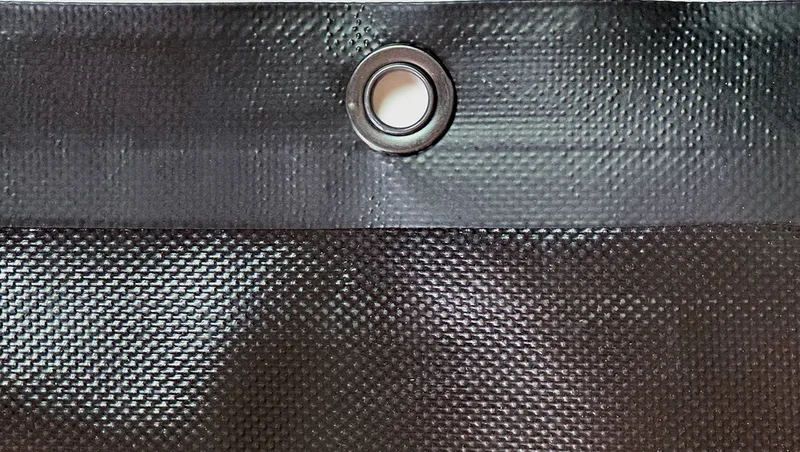
- Workhorse truck cover; solid and tough
- Suitable for use with asphalt
- Stocked in black with 10 color options available upon request
- Keeps cargo dry and out of the wind
- 100% closed weave
Iron Mesh
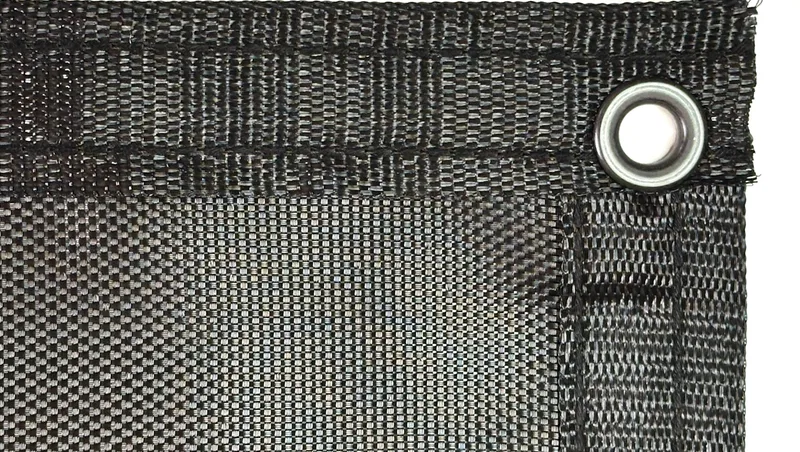
- 100% polypropylene construction
- Category-leading resistance to the outdoor elements
- Extreme high tear and rip resistance
- 8.1 oz. per square yard
- 95% closed weave
11-11 Mesh

- 1000 denier polyester yarns extrusion coated with PVC
- 11 oz. per square yard
- 11 yarns each direction per square inch
- High tear strength and UV resistance
- 51% closed weave
Multi-Mesh HD

- 1000 denier polyester yarns extrusion coated with PVC
- 10 oz. per square yard
- 11 yarns per square inch each direction
- Random colored yarns mean no two tarps will be the same
- A waste and dump truck standard; value priced
- High tear and UV resistance
- 54% closed weave
Maxi Mesh

- 1000 denier polyester yarns extrusion coated with PVC
- 9 oz. per square yard
- 12 yarns per square inch each direction
- White color stays cooler in sun
- Flame resistant
- High tear and UV resistance
- 72% closed weave
Super Mesh

- 1000 denier polyethylene yarns extrusion coated with PVC
- 6 oz. per square yard
- 15 yarns per square inch each direction
- Best bang for the buck
- Extreme flexibility
- 55% closed weave
Construction quality matters as much as material. At Humphrys, every dump truck tarp is manufactured in our USA facilities with heat-welded seams, three-ply hems, double-stitched reinforced pockets, and brass grommets built for years of daily use. For a deeper comparison of materials, thickness ratings, and applications, see our tarp buying guide.
Frequently Asked Questions
Does federal law require dump truck tarping?
Federal FMCSA regulations under 49 CFR Parts 392 and 393 require that cargo be secured to prevent it from leaking, spilling, blowing, or falling from commercial vehicles. While the regulation does not use the word "tarp" in every provision, the practical effect is that loose materials like aggregate, sand, gravel, and construction debris require a tarp or equivalent containment system.
Which states have the strictest dump truck tarping laws?
California, Arizona, Hawaii, and Washington are generally considered the strictest. California requires specific equipment configurations beyond just a tarp, including splash flaps, center flaps, and sealed dump gates for aggregate loads. Washington classifies non-compliance as a gross misdemeanor. Arizona imposes escalating fines based on the severity of the resulting damage or injury.
What is the maximum fine for a dump truck tarping violation?
Fines vary significantly by state. Most states impose fines ranging from $100 to $500 for first offenses that do not cause damage. States like Arizona can fine up to $1,000 for violations resulting in death. Washington state and Washington, D.C. classify certain violations as gross misdemeanors, which can carry imprisonment in addition to fines. Some states impose fines up to $5,000 for repeated or severe violations.
Do I need to tarp my dump truck if my state doesn't require it?
Yes. Federal FMCSA regulations apply in every state and require that loads be secured to prevent material from escaping during transport. Even in states without explicit tarping laws, load spillage and securement violations carry fines and penalties. Tarping your load in every state is the simplest way to maintain compliance and protect against liability.
What type of tarp is best for dump truck compliance?
Heavy-duty 18 oz vinyl is the most common and versatile choice for dump truck tarping. It provides full waterproof coverage, resists tearing from aggregate contact, and withstands repeated deployment cycles. For asphalt hauling, vinyl is essential due to the high temperatures involved. Mesh tarps work for specific debris containment applications but do not satisfy full-coverage tarping requirements in all states. Whatever material you choose, ensure the tarp has reinforced seams, corrosion-resistant grommets, and is properly sized to fully cover the load.
How often should I inspect my dump truck tarp?
Inspect your tarp visually before every haul. Look for tears, worn seams, and loose or corroded grommets. DOT inspectors evaluate tarp condition during roadside inspections, and visible damage can result in a violation. Replace tarps at the first sign of structural failure rather than continuing to use compromised equipment. For a step-by-step walkthrough, see our dump truck tarp replacement guide.


